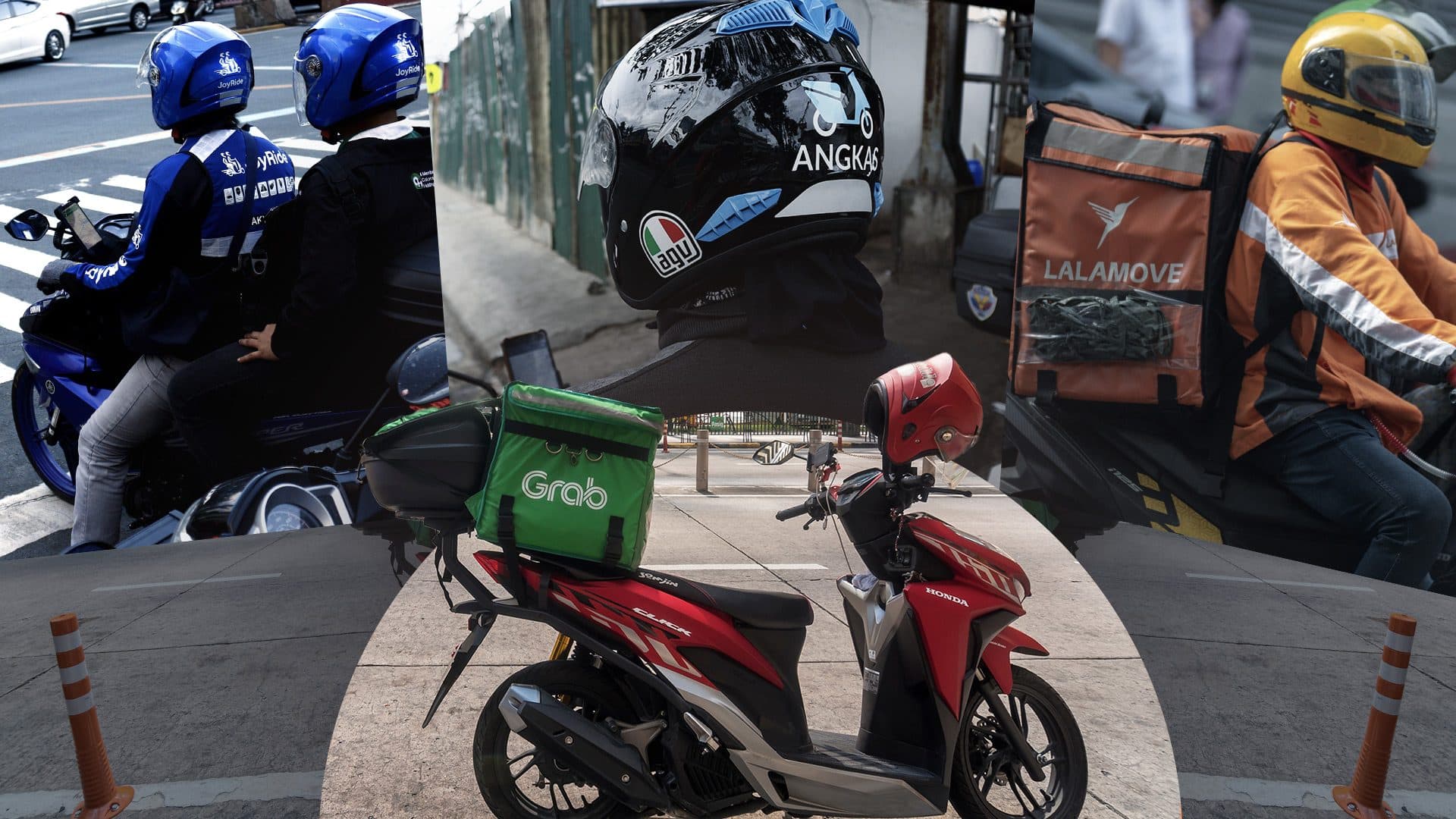
The oil crisis demands more than band-aid solutions for platform-based transport and delivery services, like Grab, Food Panda, Maxim, Lalamove, Angkas, TokTok, and Joyride
Bong (not his real name) used to work as an OFW in the Middle East. When his contract wasn’t renewed due to health reasons, he turned to platform-based ride-hailing — one of the Philippines’ fastest-growing sources of “flexible” employment. Today, he works 15 to 18 hours a day just to break even.
It wasn’t always this way. Before the recent surge in fuel prices, Bong could clear around P1,000 after expenses in 8 to 10 hours. But like the millions of platform workers across the country – from car ride-hail to motorcycle taxi and to food and courier delivery — Bong is classified by the platform as an “independent contractor.” It means he absorbs every cost on behalf of the platform: fuel, mobile data, vehicle maintenance, and amortization or boundary fees paid to the operator.
On top of these, he services a daily loan deduction of over P200 drawn directly from his app wallet — a loan he took from the very platform he works for. The oil price shock triggered by the US-Israel-Iran conflict has made this situation impossible to ignore, with local oil prices shooting up to double since the war broke out. As of March 24, 2026, diesel prices have risen to P134.30 per liter, while gasoline price is projected to exceed P100 per liter, leaving millions of Filipino workers, especially those who depend on their vehicles as a source of livelihood, to absorb the costs on their own.
The platform model: Flexibility as a cover for risk transfer The Philippines is home to a growing ecosystem of platform-based transport and delivery services. Labor platforms such as Grab, Foodpanda, Maxim, and Lalamove — as well as local players like Angkas, TokTok, and Joyride — have expanded rapidly. Around 1.7 million of the 9.9 million gig workers (22% of the Philippine population) are engaged by online platforms or mobile applications, based on the May and June 2021 Labor Force Survey.
Meanwhile, Fairwork Philippines 2025 research estimates that 856,500 workers are engaged in 10 of the largest location-based platforms, and many (along with inter-generational households) depend on it as their primary livelihood. The “independent contractor” label these platforms rely on is, in practice, a mechanism for pushing business risk down to already-marginalized workers. This sounds empowering — free, flexible, entrepreneurial — but the operational reality tells a different story.
Platforms simultaneously cut a commission from every transaction (some at 10%, but others cut as high as 24%), set the pricing of gigs and routes to take, dictate conduct and uniform policies, control the scheduling of gigs and how this should be carried out, and retain full authority over suspensions and deactivations. They also decide on what worker data to gather and use — data that may be used to offer the very financial products, like in-app loans, that workers then become trapped in. The estimated cost breakdown below makes the squeeze concrete: Work-related costs workers shoulder*Data from the Fairwork 2023 report and launchCurrent data**Vehicle amortizationP90 ($US 1.60)P115 ($US 2.05)FuelP150 ($US 2.70) (fuel for 8-12hrs)P350 ($US 6.25) (fuel for 12-15 hrs)Mobile load dataP20 ($US 0.36)P20 ($US 0.36)Vehicle maintenance (oil, tire, brakes, belts, chain)P30 ($US 0.53)P85 ($US1.51) * Typical work-related costs of a motorcycle taxi rider**Based on March 2026 consultations with worker groups Rising fuel costs also ripple into inflation, leading to increasing prices of consumer goods such as food and other basic services that also impact workers.
Resilience isn’t just about typhoons or extreme heat Our ongoing research, “Resilient Platform Work Philippines,” has largely focused on extreme weather — and for good reason. The Philippines is among the world’s most climate-vulnerable countries, and platform workers face direct exposure: riding through severe floods, enduring heat stress, absorbing income losses during supertyphoons, and taking on repair loans after weather damage. These are recurring realities workers have and already continually experience.
They can only worsen amid predictions of worsening climate conditions. But the oil price surge asks us to expand our frame. Resilience is not only a climate question — it is a geopolitical and a structural one.
The same workers who absorb the costs of a supertyphoon now absorb the costs of a war they have no part in. Whether we are talking of climate or man-made conflict, the mechanisms of platform management allows platforms to externalize risk, while workers internalize it. One-off government assistance (or ayuda), if it even reaches platform workers, provides timely temporary relief but cannot substitute for structural protection.
What the current crisis exposes is a gap in the architecture of our social protection programs and how we continually accept systems where we create jobs that have no accompanying safety nets. Informality is longstanding in the Philippines, but the lack of mandatory social protection for pl