Workers and journalists stand in front of a building in Tehran, which was hit by US-Israel air strikes days before a ceasefire took effect last week.—AFP • Says dialogue with Iran may resume within two days as diplomatic efforts intensify• PM Shehbaz set to visit S. Arabia, Turkiye as Dar meets top diplomats• China warns naval blockade of Hormuz to aggravate confrontation• Iranian president pra
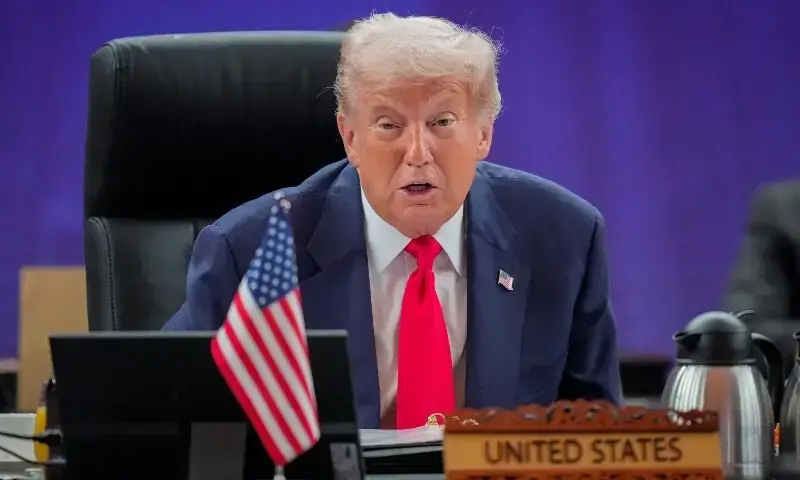
Workers and journalists stand in front of a building in Tehran, which was hit by US-Israel air strikes days before a ceasefire took effect last week.—AFP • Says dialogue with Iran may resume within two days as diplomatic efforts intensify• PM Shehbaz set to visit S. Arabia, Turkiye as Dar meets top diplomats• China warns naval blockade of Hormuz to aggravate confrontation• Iranian president praises states for stance against ‘warmongering’ Israel• Macron urges Trump, Pezeshkian to resume talks, include Lebanon in ceasefire• Xi meets UAE leadership, puts forward four-point proposal WASHINGTON/ISLAMABAD: US President Donald Trump on Tuesday hinted at a possible second round of talks with Iran in Islamabad within days, even as Washington stepped up military pressure by enforcing a naval blockade on Iranian ports following the failure of weekend negotiations.
Speaking to the New York Post in a phone interview, Trump said fresh talks could take place in Pakistan “over the next two days”, indicating a shift in his earlier position. After saying in an initial call that talks were unlikely to return to Pakistan, the NYP said Mr Trump called back minutes later to say it was “more likely” they would go back to Islamabad. “It’s more likely, you know why?
Because the Field Marshal (Asim Munir) is doing a great job. He’s fantastic, and therefore it’s more likely that we go back there,” Trump said. “Why should we go to some country that has nothing to do with it?” The remarks came days after the inaugural round of direct Iran-US dialogue, mediated by Pakistan, ended in Islamabad without an agreement despite nearly 21 hours of talks.
While no breakthrough was achieved, both sides indicated that the diplomatic channel remained open. Earlier, US Vice President J.D. Vance, who headed the American delegation during the Islamabad Talks, also praised Prime Minister Shehbaz Sharif and Field Marshal Munir for their role in facilitating talks between the United States and Iran.
In an interview with Fox News, Mr Vance described both leaders as exceptional hosts and commended their statesmanship in helping mediate discussions between the two countries. Blockade enforced The US military said on Tuesday that it successfully stopped six ships from sailing out of Iranian ports during the first 24 hours of a naval blockade against the Islamic republic. Central Command (CENTCOM) — which is responsible for American forces in the Middle East — said more than 10,000 US troops, over a dozen warships and dozens of aircraft are taking part in the mission.
“During the first 24 hours, no ships made it past the US blockade and six merchant vessels complied with direction from US forces to turn around to re-enter an Iranian port on the Gulf of Oman,” CENTCOM said in a post on X. “The blockade is being enforced impartially against vessels of all nations entering or departing Iranian ports and coastal areas, including all Iranian ports on the Arabian Gulf and Gulf of Oman,” it added. But despite CENTCOM’s assertion that no vessels made it through the blockade, tracking information from maritime data provider Kpler showed at least two ships sailing from Iranian ports crossed the Strait of Hormuz on Monday.
Tehran’s forces effectively closed the strait after the start of the US-Israeli air campaign against Iran on Feb 28, and the US on Sunday announced its own blockade after peace talks with Iran failed. Pakistan’s efforts Pakistan, which hosted the first round of talks, continued diplomatic outreach amid rising tensions. Deputy Prime Minister and Foreign Minister Ishaq Dar held meetings in Islamabad with senior diplomats from Turkiye, Egypt and Saudi Arabia, appreciating the convergence of the four countries on global matters, the Foreign Office said.
In a post on X, the Foreign ministry said that Mr Dar “met with Musa Kulaklikaya, Deputy Foreign Minister of Turkiye; Ambassador Nazih El Naggari, Assistant Foreign Minister of Egypt, and Prince Dr Abdullah bin Khalid bin Saud Al-Kabeer Al-Saud, Director General of the MFA of Saudi Arabia”. During the meeting, Mr Dar lauded the “convergence of views on important regional and global matters among the four brotherly countries”. He stressed the need for “devising a cooperative framework among the four countries, focusing on the shared goals of peace, prosperity and economic development”.
The diplomats are in the country for the inaugural meeting of “Senior Officials’ Meeting of four countries (Pakistan, Saudi Arabia, Turkiye and Egypt), held today in Islamabad,” the Foreign Office said. Separately, during a meeting with Prime Minister Shehbaz Sharif, President Asif Ali Zardari praised Pakistan’s role in facilitating the Iran-US dialogue and called it an important contribution to regional peace and stability. He urged continued engagement with both Washington and Tehran, as well as other global powers, to sustain the fragile diplomatic process. During the meeting, the prime minister took the president into co