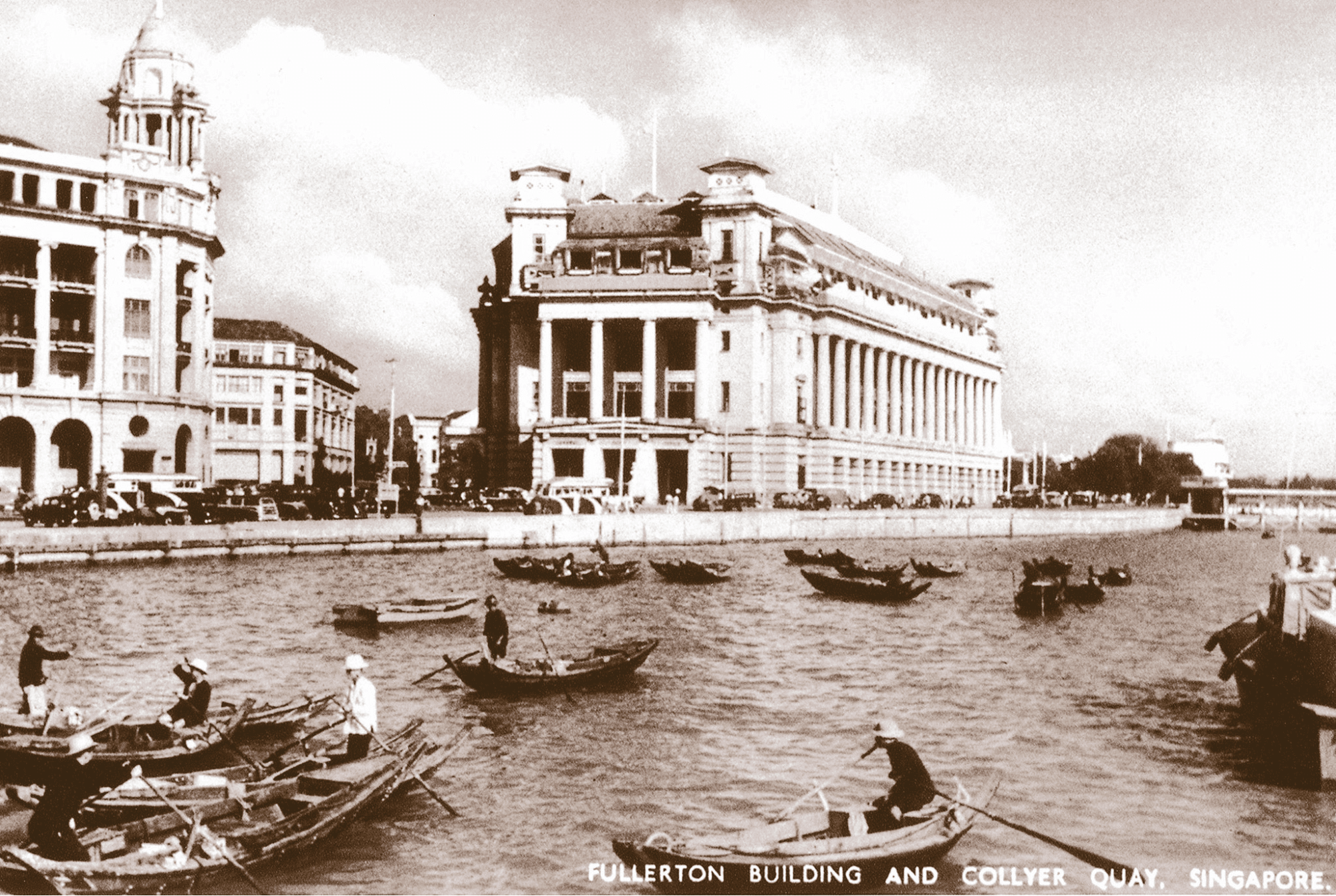
The Fullerton Hotel Today, you know The Fullerton Hotel as one of the best hotels to catch NDP fireworks at, but did you know that it used to house Singapore’s General Post Office (GPO)? Or that, as one of Singapore’s oldest buildings, it has a history dating back to the 1800s? Originally a fort guardingContinue reading "The Fullerton Building Used To Be SG’s General Post Office, With Original Arc
The Fullerton Hotel Today, you know The Fullerton Hotel as one of the best hotels to catch NDP fireworks at, but did you know that it used to house Singapore’s General Post Office (GPO)? Or that, as one of Singapore’s oldest buildings, it has a history dating back to the 1800s? Originally a fort guarding the SG River The Rocky Point on which Fullerton Fort was built.
Image credit: Fullerton Heritage Throwing us back to Singapore’s founding days is what was once Fort Fullerton, named for Robert Fullerton, the first governor of the Straits Settlements. Built in 1829, it was meant to defend the mouth of the Singapore River; later extensions saw it enlarged to 3 times its original size, stretching all the way to Johnston’s Pier. Fullerton Square, 1867.
Image credit: National Museum of Singapore Collection In 1872, a government review revealed that the fort was in line with the busiest and most valuable part of the town – should the fort be attacked, the town would likely be destroyed. Thus, it was decided that the fort should be demolished. Housed SG’s General Post Office Construction of Fullerton Building in 1919.
Image credit: Historic Hotels Built at a cost of $4.75m – or approximately $100m in today’s currency, Fullerton Building was officially opened on 27th June 1928, after being commissioned by the colonial government as the new headquarters for the mail service. Aerial view of Fullerton Building after completion, in 1928. Image credit: Historic Hotels Designed by government architect Major Percy Hubert Keys and his assistant Frank Dowdeswell, who later left to establish a private architectural firm, Keys & Dowdeswell, the building was 37m tall, with fluted colonnades on its base, a portico with trophy designs, and 14 elevators.
Image credit: Glenn Low via Facebook A few weeks later, the General Post Office took up residence. Whatever mail was dropped in the post boxes would fall to the sub-ground floor, where it would be caught on a band conveyor and sent to the sorting room. Image credit: Dolby Thx via Facebook This sub-ground floor, FYI, was connected to a subway that ran beneath Fullerton Road to the Post Office Pier, facilitating the transfer and pick up of overseas mail.
Image credit: The Fullerton Heritage via Facebook Though the GPO was the anchor tenant of the Fullerton Building, the Singapore Club could be found in the upper floors, housing atas amenities including dining rooms, club rooms, billiards and card rooms, and accommodation rooms too. Over the years, other government organisations took up office here as well, including the Inland Revenue Department, and the Singapore Chamber of Commerce. A makeshift hospital during WW2 Image credit: Historic Hotels It was here at the Singapore Club that then-Governor Shenton Thomas was residing when the British forces surrendered to the invading Japanese military on 14th February 1942.
In those last days, the building was also a makeshift hospital, complete with operating rooms, for wounded soldiers. Japanese troops in front of Fullerton Building after the fall of Singapore. Image credit: Heritage SG Memories via Facebook During the Japanese Occupation, it would become the headquarters of the Japanese Military Administration Department, where they would receive a $50m cheque from the Overseas Chinese Association.
This sum, demanded by the Japanese, was raised by the Chinese in Singapore and Malaya as atonement for the Chinese resistance against the Japanese invasion of Malaya, Singapore and China. Where Fullerton Lighthouse used to stand Image credit: Fullerton Heritage On top of Fullerton Building used to stand Fullerton Lighthouse – one of 3 lighthouses which used to stand at Singapore Harbour. Erected in 1958, it would flash 4 times every 20 seconds, and could be seen from as far as 29km away.
It was eventually decommissioned 20 years later, and can now be found at Harbourfront Tower 1, where you take the Singapore Cable Car to Sentosa. Transformation into a 5* hotel Image credit: The Fullerton Hotels In 1996, the GPO moved out of Fullerton Building, then converted into what is The Fullerton Hotel Singapore today – in 2015, it was gazetted as a national monument, with much of its original architectural features still preserved. Travel back in time with an SG Culture Pass-eligible tour View this post on Instagram Take a trip back through the decades with a walking tour such as The Fullerton Heritage Spice Trail, where you’ll get to walk through the old mail tunnels and enjoy a heritage tea break featuring the spices which our maritime past was built on.
Best of all, you can book the tour using your SG Culture Pass credits. The Fullerton Hotel building & its history These walls really have seen entire lifetimes worth of tales – if only they could talk. The next time you walk past The Fullerton Hotel, pause and have a look at what could well be a cornerstone of present-day Singapore. For more heritage content: Visit SG’s oldest colonial bungalow in Si