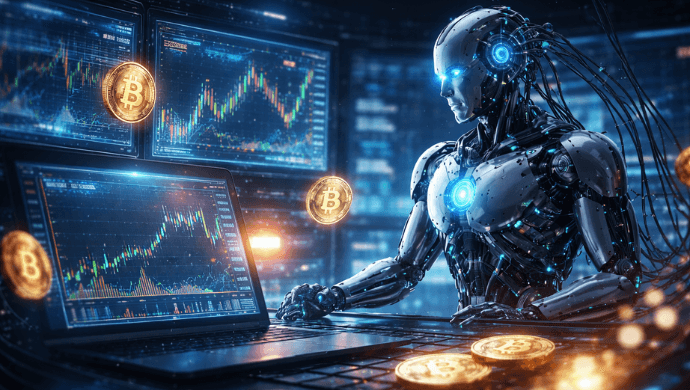
The integration of Artificial Intelligence into cryptocurrency trading in 2026 represents a paradigm shift that functions as a double-edged sword. While this technological evolution offers unprecedented speed and discipline to market participants, it simultaneously introduces systemic risks and sophisticated new vectors for fraud. As the landscape matures, understanding the dichotomy between the r
evolutionary capabilities of AI agents and the inherent dangers they pose is critical for any investor navigating the digital asset space. On the side of innovation, AI is fundamentally revolutionising trading mechanics through lightning speed and efficiency. AI agents possess the capacity to process massive datasets and execute thousands of trades in milliseconds, a feat that dwarfs human capability.
Where a human trader requires between 0.1 to 0.3 seconds to react to market changes, AI operates on a timescale that renders manual intervention obsolete for high-frequency strategies. Beyond mere speed, these systems provide emotion-free discipline. By removing the psychological enemies of trading, specifically fear and greed, AI allows strategies to remain consistent even during volatile market dips or euphoric hype cycles.
This mechanical consistency ensures that trading decisions are based purely on data rather than impulse. Furthermore, AI provides 24/7 global vigilance that human traders cannot match. Unlike individuals who require rest, AI bots monitor global markets, news sentiment, and social media platforms such as X and Discord round-the-clock without fatigue.
This constant surveillance is complemented by the democratisation of tools. Platforms like Token Metrics and BitsStrategy now provide retail traders with institutional-grade analytical tools that were once reserved for elite hedge funds. Within this framework, AI excels at sophisticated strategy detection, identifying micro-price shifts, cross-chain arbitrage opportunities, and whale wallet movements that remain invisible to manual analysis.
Also Read: Binance cracks down on market makers: What traders need to know now However, these advantages are counterbalanced by significant risks and Black Swan dangers. A primary concern is systemic volatility and the potential for flash crashes. When thousands of AI bots react to the same signals or news events simultaneously, they can trigger chain reactions that lead to sudden market distortions.
Compounding this instability is the rise of AI-powered scams. Fraudsters are now weaponising AI to create hyper-realistic deepfakes of celebrities promoting rug pull projects and ghost platforms that vanish immediately after users deposit funds. Operational opacity presents another challenge known as the Black Box problem.
Many advanced deep-learning models are non-transparent, meaning even their developers may not fully understand why an AI chose a specific, potentially disastrous trade. This lack of explainability is exacerbated by issues regarding overfitting and stale data. Models often memorise past history and fail during new, unprecedented events, such as sudden regulatory shifts or exchange hacks, where historical patterns no longer apply.
Additionally, security vulnerabilities remain a critical concern. Utilising third-party AI bots often requires sharing API keys, and if the bot provider is compromised, users’ entire exchange accounts can be drained instantly. To navigate this complex environment, traders must adopt key strategic recommendations for 2026.
It is imperative to never grant full authority to automated systems. Users should configure trade-only API keys and always disable withdrawal permissions for any automated bot to mitigate the risk of capital theft. Furthermore, maintaining a human kill switch is essential.
Investors must retain manual oversight to pause bots during major news events, such as regulatory announcements, which AI models cannot predict or contextualise effectively. Finally, traders must verify auditable claims rather than falling for marketing hype. Investors should avoid bots promising unrealistic win rates and instead look for platforms with transparent, live performance data.
By balancing the transformative power of AI with rigorous risk management, traders can harness the benefits of automation while safeguarding against its inherent pitfalls. — Editor’s note: e27 aims to foster thought leadership by publishing views from the community. You can also share your perspective by submitting an article, video, podcast, or infographic. The views expressed in this article are those of the author and do not necessarily reflect the official policy or position of e27. Join us on WhatsApp, Instagram, Facebook, X, and LinkedIn to stay connected.