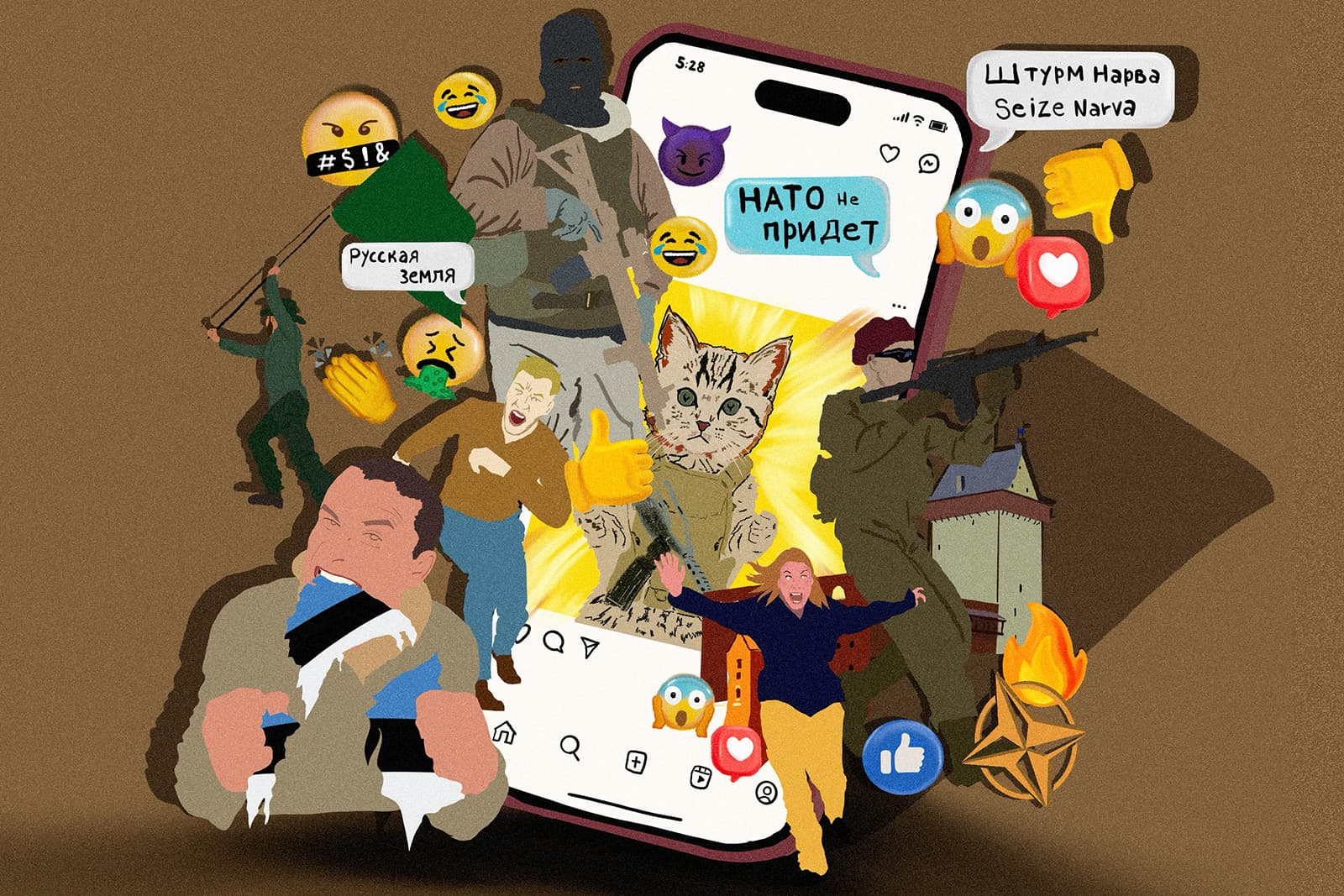
Inside the People's Republic that wasn't.
How a fake Russian story became a real problem for Estonia A sprawling fraud trial involving former premier Joseph Muscat lays bare the costs of 12 years of gangbuster growth. By EVA HARTOGin NARVA, Estonia Illustration by Natália Delgado/POLITICO Mayor Katri Raik says she’d rather speak about almost anything else. Spiking gas prices, how to revive an aging region, the danger of stray Ukrainian drones — anything but the online chatter that her city, Estonia’s third-largest, is about to break away from the rest of the country to create a Russia-friendly “Narva’s People Republic.” In recent weeks, a cluster of anonymous Russian-language social media accounts has been posting memes and messages calling for the takeover of Narva and the surrounding Ida-Viru county, and describing it as “Russian land.” The campaign — which echoes the information operations that preceded Russia’s incursions into Crimea and eastern Ukraine — has fueled international speculation that the Kremlin might seize the opportunity to test NATO’s eastern flank.
But for Raik, and many others in Estonia, the episode points to a different risk: A handful of Russian trolls dreaming up a destabilizing scenario and pushing it into the mainstream, with very real consequences. Mayor of Narva Katri Raik is pictured in Narva on January 16, 2026. | AFP via Getty Images “It’s a totally fake story, complete nonsense,” Raik says, visibly frustrated, speaking in a spacious, wooden-floored chamber in Narva’s city hall. “I’m scolding everyone who’s made a big deal out of this and telling them: Now I’m stuck with a problem, not you.” ‘Is Narva next?’ It’s not hard to see why the troublemakers picked Narva as their target.
Perched on Estonia’s northeastern border, with just a 100-meter river separating it from Russia, the city lies closer to St. Petersburg than Estonia’s capital Tallinn. Ninety-eight percent of Narva’s 50,000 residents are Russian-speakers.
More than a third hold Russian passports and a third are pensioners, many of whom are openly nostalgic about the time when, under Soviet occupation, the region was an industrial powerhouse. The city has flirted with secession in the past. In 1993, three years after Estonia declared independence from the Soviet Union but before Russian troops had fully withdrawn, Narva’s City Council staged an impromptu referendum on autonomy.
Of the roughly half of residents who showed up, 97 percent voted in favor. Estonia’s Supreme Court, predictably, ruled the outcome illegal and Moscow, distracted by its own internal turmoil, didn’t intervene. Narva remained part of Estonia and, since 2004, also the EU and NATO.
That history was still fresh in the minds of both Russian propagandists and Western observers when Russia annexed Crimea in 2014. Raik recalls how, in the aftermath of the annexation, journalists descended on the city with a now-familiar question: “Is Narva next?” “I had to tell them we had no little green men here,” she said, referring to the troops without insignia sent by Moscow to foment unrest in Ukraine. Russian President Vladimir Putin, however, prefers to keep his neighbors on their toes.
At a meeting with scientists and entrepreneurs in June 2022, he praised Czar Peter the Great — an 18th-century ruler he has described as a role model — for expanding into the territory that includes present-day St. Petersburg and Narva. “It seems it has fallen to us, too, to reclaim and strengthen,” Putin said at the time.
‘NATO won’t come’ The first to draw attention to the Narva online campaign was the Estonian anti-propaganda website Protastop. In a detailed article published halfway March, it detailed how Russian-language accounts on TikTok and Vkontakte, Russia’s version of Facebook, had for weeks been reposting messages and memes from a Telegram channel promoting a takeover of the region by a militia. The EU, Estonian and NATO flags fly backdropped by the Ivangorod Fortress in Narva, on January 15, 2026. | AFP via Getty Images The group shared the design for a flag, an anthem and even a timetable for the unspecified day Narva would be seized.
Wake-up would be at six, breakfast at eight, followed by the “storming” of Narva an hour later. A celebratory concert and fireworks would cap it all off. Much of the content was clearly designed to shock and entertain.
Animals, especially cats, featured heavily. One doctored post showed a small dog with the flags of Latvia, Lithuania and Estonia on its forehead, its mouth covered by a large hand. “NATO won’t come,” the caption read.
Underlying the flippant tone, Protastop warned, was a deliberate message that “normalizes the rhetoric around secession and separatism.” A week later, journalists from the Estonian outlet Postimees had managed to infiltrate the central Telegram channel. They concluded the accounts were “nothing more than a poorly executed information operation,” with only some 60 followers. By then, however, the story had snowballed, making headlines abro