Even as it reduced its global growth forecast for the year to 3.1%, the International Monetary Fund (IMF) upgraded Mexico’s forecast by one-tenth of a percentage point to 1.6%, recognizing its recovery from a year of stagflation. The post IMF lifts Mexico’s growth forecast up a tick, while reducing global expectations appeared first on Mexico News Daily
Even as it reduced its global growth forecast for the year to 3.1%, the International Monetary Fund (IMF) upgraded Mexico’s forecast by one-tenth of a percentage point, to 1.6% for 2026, recognizing its recovery from a year of stagflation. The IMF’s lowered expectations for the world as a whole were based on the Iran war. “Before the war, we were preparing to revise our forecasts upward to 3.4%,” the IMF’s chief economist, Pierre-Olivier Gourinchas, was reported as saying.
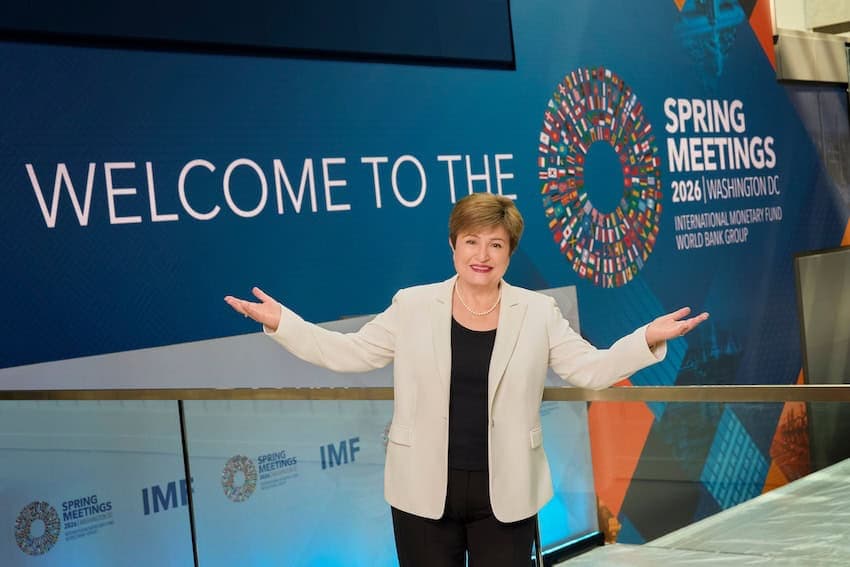
Kristalina Georgieva heads the IMF, which issued economic forecasts for Mexico, Latin America and the world as its annual meeting began on Monday in Washington, D.C. (IMF) But the pessimism is expected to be temporary. “Our baseline forecasts are based on a relatively short conflict, with a temporary disruption to the energy market that would disappear next year,” Gourinchas added. As for Mexico, the IMF raised its growth expectations to 1.6%, one-tenth of a percentage point higher than projected in January.
According to the IMF, the country is undergoing a “soft recovery” following a year of stagflation, when growth reached just 0.6%. “In Mexico, weak economic growth in 2025 amid fiscal consolidation, restrictive monetary policy and headwinds from trade tensions is expected to lead to a mild recovery,” the IMF report stated. The IMF also improved its economic outlook for Mexico in 2027, from 2.1% to 2.2%.
Meanwhile, Mexico’s Finance Ministry expects growth to fall somewhere between 1.8% and 2.8% in 2026, followed by 1.9% to 2.9% growth in 2027. In Latin America and the Caribbean, the IMF revised its forecast upward by 0.1 percentage points, to 2.3% growth. The global economy, as the IMF sees it At the IMF annual meeting in Washington, which is running through April 18, International Energy Agency Director Fatih Birol warned that April may be worse than March for global energy supply.
The increase in oil prices is expected to drive inflation to a global average of 4.4%, which is 0.6 percentage points higher than stated in the IMF’s January forecast. Also, if the Iran conflict continues, the economic impact could be much more significant, with a worst-case global growth scenario of just 2%, according to Gourinchas. “The world is facing this shock after having already endured the impact of COVID-19 and the war in Ukraine… with very little room for political maneuvering,” explained the IMF’s managing director, Kristalina Georgieva. With reports from El Economista, López-Dóriga Digital and Sin Embargo